

作者:发布时间:2026-10-22浏览:10次
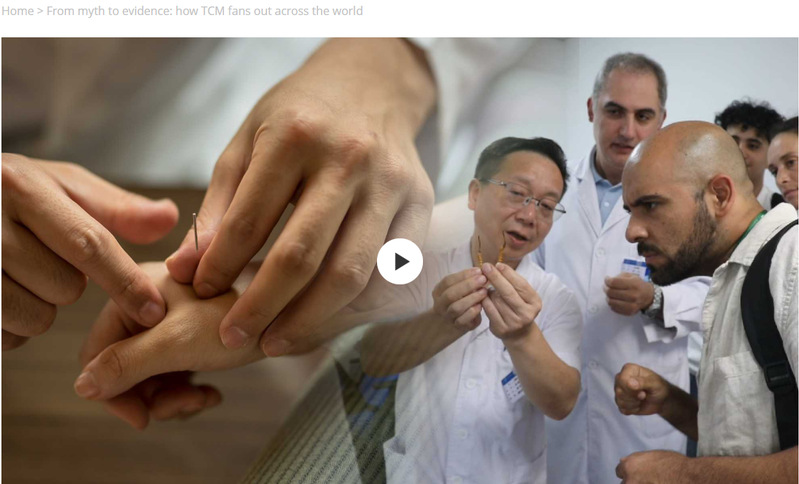
Once dismissed in the West as something mystical, traditional Chinese medicine is now being studied, practiced and taught across the globe. Modern science begins to explain how techniques like acupuncture and tuina actually work, and more countries move to regulate and recognize TCM. In this episode, we speak with TCM practitioners from China and overseas to find out how this traditional healing method is putting down roots worldwide — and what it takes to bring it into mainstream healthcare.
Are people choosing TCM in the West?
Take Thierry Vinai. He's from France, where he runs a TCM school founded by his father in 1988. His father studied acupuncture at the Shanghai University of TCM in the 1980s. Thierry was his father's very first patient. His father treated him with TCM—and it worked. This inspired him to take over the practice.
This was Thierry's 47th trip to China, and he brought a group of French doctors to study at TCM hospitals in Shanghai. We can say 70% of French people believe in Chinese medicine, says Thierry Vinai, Principal of the Institut de Médecine Traditionnelle Chinoise. Now we have 430 students, and three places in France—Paris, Avignon, and Toulouse. We give all the courses: acupuncture, tuina, and pharmacology. Five years later, they can open their own clinic.
Vaque Nathalie was one of Vinai's students and has been learning TCM for five years. I've been using Chinese medicine since I was young because there is a tradition in France of traditional Chinese medicine for a long time, she says. I think Chinese medicine is very good on the long term, you know, not to be sick and to be more relaxed, balance the body and have a good energy.
Does TCM work?
Around the world, more people are choosing TCM—not because they believe in it, but because they've seen it work. From the claims of healing herbs to pain-reducing acupuncture, TCM takes a holistic approach to health and wellness and focuses as much, if not more, on the prevention of illness as it does on treatment.
In the West, acupuncture is the most widely accepted TCM therapy and is legally recognized in 65 countries. France was the first western country to embrace it. Today, it has more than 2,600 acupuncture clinics and about 7,000 acupuncturists. One big reason behind its popularity is that it solves a problem western medicine still struggles with—pain.
Sometimes western medicine on pain is quite difficult to find the solution or the cause, Nathalie explains. And Chinese medicine is very good for that, for the pains on the body, on the back.
Today when you go to a western medicine doctor, he will just give you—oh, you just have a pain somewhere, I will give you tablets, and you deal with it, adds Chasseau Laurent, a TCM practitioner at the Institut de Médecine Traditionnelle Chinoise. But the practitioner will be there to accompany the patient and will be able to adjust the therapy, either by tuina, by pharmacopoeia or by other things.
Ignacio Moreno, an emergency doctor from Chile, has seen the benefits firsthand. It's very common that traumatologists—the doctors of bones, muscles—they have patients with a lot of pain problems. So acupuncture is really good and very quickly alleviates pain.
Gorchs Gomez, a nurse from Brazil, experienced it herself. I was given many painkillers and I didn't want to take them for my entire life. So I started with the acupuncture and it did work. So I just quit all the medication I was taking within two or three sessions.
Acupuncture is a physical therapy. It uses the mechanical stimulation of needles to activate neural pathways and release the body's own pain-relieving substances. That's why its side effects are far less than those of medication—and it can even help relieve some of the side effects caused by Western treatments.
As per my practice, I know that when people have cancer and they are getting treated by chemical drugs, they have a lot of side effects, says Lilit Kamalyan, an acupuncturist from Armenia. Then acupuncture can come to help to calm down those effects very well. It is helping so much to calm their mind, to calm those side effects like hot flashes.
Leonardo Nascimento Ferreira, a TCM practitioner in Brazil, sees broader benefits. I think just the fact that by doing acupuncture or doing some treatments with traditional medicine, you avoid the intake of some allopathic medicines, and you prevent stressing or working too much with your liver or requiring the kidney to function more. We can make the prevention and avoid further issues in the future.
Acupuncture is also increasingly being used in chronic disease management for conditions like chronic pain and diabetes—areas where western medicine often struggles with long-term control. But how does one needle do all of this?
Is TCM myth or science?
For years some have dismissed acupuncture as mystical because its effects were hard to measure or visualize. But with AI and new imaging technologies, that black box is finally being opened. In July, a team of researchers led by Dai Qionghai from Tsinghua University captured something incredible. They filmed immune cells moving along acupuncture meridians in a living body using a new AI-powered microscope. For the first time, we have real-time, molecular-level images of what ancient texts called meridians.
We've done a lot of research to explain what acupuncture actually does in the course of treating a disease, says Ming Shuren, Associate Chief Physician at the Acupuncture & Moxibustion II Department of Yueyang Hospital. If we look into it, acupuncture can indeed cause many inflammatory cells to migrate after needle insertion, and it also causes some immune cells to migrate to the local acupuncture site, thereby treating the disease. For example, we studied electrical and resistance sensitivity. When someone gets sick, acupuncture points become sensitized—their electrical resistance and conductivity change. We call these 'positive reaction points.' And when we stimulate these points with acupuncture we get good results.
While acupuncture gets most of the attention, the TCM therapy tuina is quietly being validated by modern science. Treating disease, relieving pain, and restoring physical function… it's not just a massage.
We use biomechanics to study the effects of tuina and bone setting—looking at changes in posture, changes in gait after treatment, says Zhang Hao, Associate Chief Physician at the Tuina Department of Shuguang Hospital. We use neuroscience to study how tuina relieves pain, releases muscle tension, improves gut function—even how it regulates the autonomic nervous system. These are all things we're working on. And our researchers—many of them are also doctors—we work together to validate tuina's effectiveness using modern scientific methods. This is ongoing work.
Traditional Chinese medicine is not about mysterious potions, stereotypes and forbidden prescriptions. It's a scientifically based method for tapping into the body's natural healing abilities. It's a tried and true method of evidence-based healing that dates back thousands of years.
If we search for articles published in medical journals, there are more and more articles trying to explain the mechanisms through the lens of western medicine, says Abdi Meghdad, a physician assistant from Iran at the International Medical Department of Yueyang Hospital. These were not available maybe 30, 40 years ago. So this shows that science maybe needs more time. The important thing is the therapeutic effect. And the therapeutic effect can already be shown very well in the research—by the research methods of western medicine, through the strict research methodologies—for acupuncture, herbal medicine.
Is TCM legally recognized outside of China?
So the science is catching up. More research, more evidence, more mechanisms explained. But regulation, licensing and insurance are a different game. So here's the question: is TCM legal outside of China?
TE KIAN KEONG is Malaysian Chinese. He serves as the director of the Traditional and Complementary Medicine Center at a university in Malaysia. He's not just a practitioner; he also works in R&D and bringing TCM to the international stage. He's watched TCM grow in Malaysia over the years.
The milestone of TCM development in Malaysia is the Traditional and Complementary Act 2016, also called X775. So this is the regulations of Malaysia. TCM practice also is a recognized area under this act. All the TCM practitioners are requested to register under Traditional and Complementary Medicine Council, says TE KIAN KEONG. TCM originally is a community healthcare. So right now it's going to the professional regulated healthcare. For the time being, I assume the number of TCM practitioner is about 10 thousands in Malaysia. So, and then we have a lot of TCM treatment centers going up very fast.
The World Health Organization says 113 of its member states now officially recognize TCM, 29 have laws in place, and 20 even cover it under national health insurance programs. This year, our president sanctioned regulations, so it's under regulation right now, acupuncture in Brazil. We're starting to develop courses for bachelor's degree, says Leonardo. And I'm very happy that we're doing this regulation, and it's widespread now.
But here's the catch: even though TCM is spreading fast it still struggles to meet Western medical standards. Different logic, different rules. And that makes legalization a challenge.
But here's what's happening in response. Since 2009, the ISO (International Organization for Standardization) has had a technical committee dedicated to traditional medicine—ISO/TC 249. Its secretariat is located at Shanghai University of Traditional Chinese Medicine. The committee has published 149 international standards so far, covering everything from acupuncture needles to herbal quality to terminology. Now countries can reference ISO standards as a technical baseline when they draft their own TCM regulations.
We still need high-quality critical research come with the good values to tell the people, to tell the other health fields about the value of TCM, TE KIAN KEONG says. We need the position to put the good position for TCM to merge with the current healthcare system.
A new generation carries it forward
Despite the challenges, TCM's global influence keeps growing. Every year, thousands of people come to China to seek treatment or study TCM. And they return to their home countries, using what they've learned to help patients there.
The countries that are open to both western medicine and Chinese medicine—that's the correct way, says Abdi. It's a great opportunity, because China has done a lot of research, a lot of trial and error to establish this integration. And this establishment is already successful. And it's a great opportunity for other countries to also open their minds and accept, learn from it. And then the first group that benefits the most are the patients.
TCM is putting down roots from one generation to the next in places far from China. Like Thierry Vinai, who took over his father's TCM school in France. For over 40 years, he's been traveling between China and France training the next generation of practitioners.
And the same thing is happening in TE KIAN KEONG's family. This year, his daughter stepped into Shanghai University of Traditional Chinese Medicine—the same school where her father once studied. A new chapter begins. A new generation carries it forward.
It feels very special, because this is also the place that he studied when he was young. Now I'm a student here, too, she says. I will keep learning TCM. And I hope that I can explore and find the area of TCM that I really enjoy.
本文发布于魔都眼,2026年10月22日,记者:唐晓帆。
Copyright © 美加墨世界杯(官方中文网站) - FIFA World Cup 2026版权所有沪公网安备 31011502015203号

 当前您的位置:


